
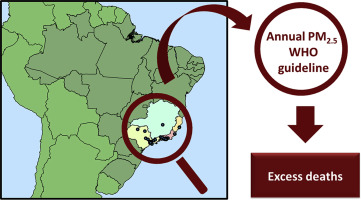
Excess deaths associated with fine particulate matter in Brazilian cities
Willian L. Andreão, Taciana T. A. Albuquerque, Prashant Kumar
Highlights
- Brazilian air quality monitoring data from 24 cities were used to estimate avoidable deaths.
- Almost 90% of the annual PM2.5 concentrations in Brazilian cities were higher than WHO guideline.
- Large urban centers such as Sao Paulo city obtained higher values of avoidable deaths.
- National PM2.5 standard in Brazil based on WHO guideline could bring health-related benefits.
Abstract
Fine particulate matter (PM2.5; ≤2.5 μm in aerodynamic diameter) stands out among all pollutants as more directly responsible for long-term health problems. This work aims to evaluate the public health benefits of improved air quality in Brazil, based on the estimated reduction in mortality from PM2.5, a pollutant commonly related to all causes mortality including non-accidental, cardiovascular, ischemic heart diseases and lung cancer. Annual PM2.5 concentrations were obtained from 50 monitoring stations spread across 24 Brazilian cities between the years 2000 and 2017, which constituted the baseline scenario. The control scenario was represented by the annual PM2.5 guideline values (10 μg m−3) of the World Health Organization (WHO). The relationship between the change in baseline and control scenarios with health effects was estimated using the BenMAP-CE program and the application of exposure-response functions. São Paulo city showed the highest number of avoidable deaths, with values ranging from 28,874 ± 9769 and 82,720 ± 24,549 for all causes from 2000 to 2017. In 2009, just three Brazilian cities were monitoring PM2.5. Between 877 ± 295 and 2497 ± 719 all causes avoidable deaths related to PM2.5 were estimated under the scenario when the WHO guideline was applied. In 2017, the 15 cities with representative annual PM2.5 data account for between 2378 ± 801 and 6282 ± 1818 avoidable deaths due to all-cause PM2.5 mortality, between 2974 ± 376 and 10,397 ± 516 avoidable deaths due non-accidental causes, between 1373 ± 230 and 3428 ± 265 avoidable deaths due cardiovascular disease, between 927 ± 162 and 2514 ± 156 avoidable deaths due ischemic heart diseases and the lowest between 101 ± 45 and 264 ± 88 avoidable deaths due to lung cancer